Coca-Cola is one of the most recognisable brands in the world. This popular American soft drink brand was established in 1886 by John Stith Pemberton. Its iconic logo has been a key part of its identity and global appeal. This article explores the origins and evolution of the Coca-Cola logo over the past century.
The Genesis of the Coca-Cola Logo (1886-1887)
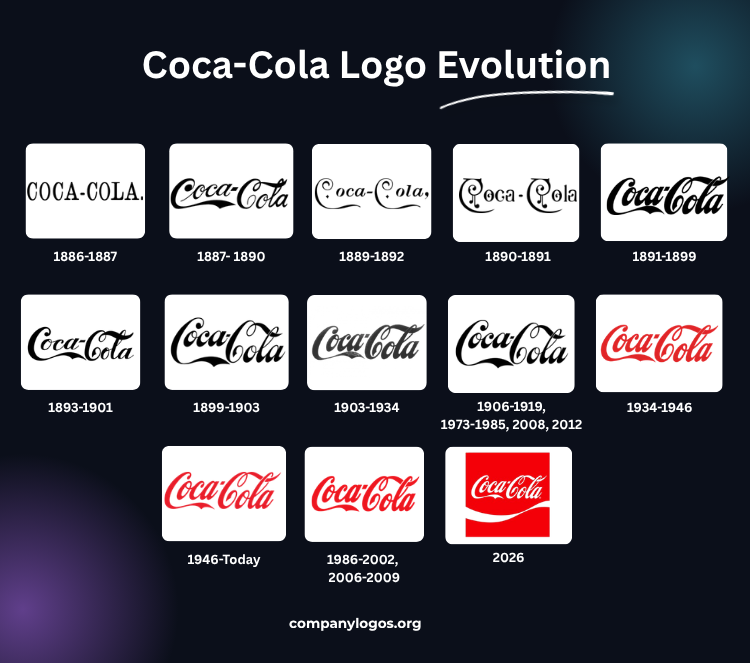
The first Coca-Cola logo was created in 1886 by Pemberton’s bookkeeper, Frank Mason Robinson. The latter wrote the words “Coca Cola” by hand in the now-famous Spencerian script, which was popular in advertising at the time. The cursive letters slanted right in simple serifs to give an impression of motion and energy.

(1887- 1890)
After the original logo, a need was felt by the company founder, John S. Pemberton, to create a more distinctive logo. So, the Spencerian script appeared for the first time during this period. The logotype in black displayed an ornate styling where the letters “C” had an elongated ribbon-like tail and a twisted loop.

(1889-1892)
In 1889, the elegant iteration of the logo saw both “Cs” with elongated curved lines. And after the letters “C,” there were two small diamond-like elements and a bold comma at the end.

(1890-1891)
In 1890, the Coca-Cola typeface had decorative swirls, especially with the letter “C.”

(1891-1899)
The logo of this period was a refined variant of the logo of 1897. However, the colour palette was a vibrant red set against a white background.

(1893-1901)
The logo of 1887 was reproduced using emboldened lines and lettering. The sharp and bold details of some letters added strength to the overall logo.

(1899-1903)
In 1899, the previous logo was refined by rendering the individual letters more balanced. This particular logo looked smoother and is similar to the current iconic logo.

(1903-1934)
The logo of this period looked like the current one but had taller contours of the individual letters. Also, the words “TRADE MARK REGISTERED” appeared on the tail of the letter “C.” The overall perception of this design is that it is more refined than its original variant.

(1906-1919) (1973-1985), (2008,2012)
The logo created during these periods used to be displayed on the bottles and also used as commemorative bottles for anniversaries or special occasions.

(1934-1946)
In 1934, the logotype in red was made more stylish with thicker tails and contours of individual letters..

(1946-Today)
In 1946, the previous version was refined and made more italicised. This particular iteration has become notably the most iconic design from Coca-Cola to date.

(1986-2002) (2006-2009)
In 1986, the logotype was refined by making it bolder and streamlined. The glyphs appeared to have straightened, but the overall style remained the same.

(2026): A Refreshing Coca-Cola Logo
On 20th July 2026, the Coca-Cola company revealed a fresh yet familiar brand identity system.
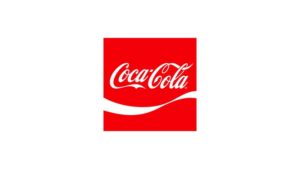
Agency JKR (Jones Knowles Ritchie) designed the new Coca-Cola logo by highlighting the iconic elements in their full glory. The distinctive red-white color palette appears more noticeable, the Spencerian script spelling the brand name is accentuated, and the Arden Square is more profound. But the all-famous and dynamic ribbon gets a drastic makeover.
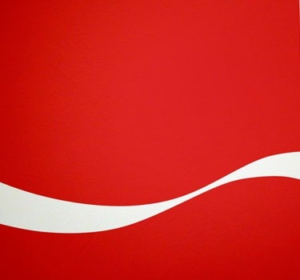
Drawing parallels from the curves of the popular Coca-Cola bottle, the flowy dynamic ribbon was first introduced in 1969 on cans, signs, and other brand touchpoints. Now it has been revived by JKR as a consistent brandmark that ties all the other elements together.
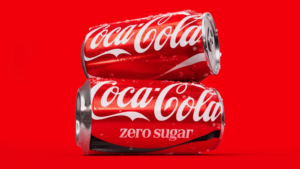
The ribbon on Coke Zero Sugar cans and its PET packaging cap also got a fresh look, now appearing in sleek black.
To ensure a harmonized brand image worldwide, the giant beverage company has launched a design intelligence tool. The technology will help internal marketing teams and agencies maintain a consistent branding across all brand touchpoints in over 200+ countries.
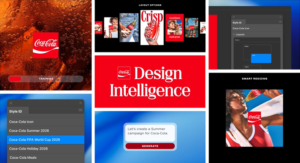
Arnab Roy, President, Coca‑Cola Global Category, unveiled this change by stating, “This refresh is about being clearer and more consistent in how we show up, wherever people experience our brand. By building on the things people already know and love, we’re creating a stronger foundation for growth while staying unmistakably Coca‑Cola.”
The company also announced that the refreshed brand aesthetics will be rolled out in Latin America, Europe, the Middle East, and Asia.
Global Adaptations and Localised Logos
While Coca-Cola maintains brand unity globally, there are unique localised variations of the logo. In China, the logo is rendered in Chinese characters. For the Middle East market, the flowing Arabic script is incorporated. Sometimes the letters are depicted in gold to appeal to regional tastes. The basic elements remain, but the stylistic execution adapts. For Christmas branding, the logo often includes winter scenery like snowflakes and Christmas trees to resonate culturally. The company balances standardisation with targeted customisation.
The Elements of the Coca-Cola Logo
Font
The brand name contains only text, and the font looks like handwriting. In the logo, the first letter “C” is separate from the rest with long, decorative curls. This is a Spencerian script from the 1840s, which was used in the USA until typewriters arrived on the scene. In 1890–1891, the letters looked different with many dots and curls. This created a forest feeling. But the owners went back to the Spencerian font and stopped such experiments.
Colour
Until 1891, the Coca-Cola logos were black and white. Thereafter, Coca-Cola began to use bright red and did away with black colour. However, the colour white stays in the background. During the evolution of the logo, the colours have changed occasionally. For example, white text written on a red background. The colours were so used because red and white mean purity, optimism, and youth.
Finally
The Coca-Cola logo has transformed dramatically over the past 130 years, from its ornate Victorian script to sleek modern interpretations. The flowing Spencerian letters, iconic bottle silhouette, dynamic ribbon, and wavy design have each represented different eras in Coca-Cola’s marketing. The iconic logo exemplifies the globally recognised brand identity. As tastes and trends change in the future, the Coca-Cola logo will continue to adapt. But it is likely to remain one of the most distinctive logos ever.