The Nike baseball logos stand as a tribute to the legendary athletes who shaped the sport into a timeless, deeply rooted culture of America’s pastime.
Let’s explore the iconic Nike baseball logos that strengthened the bond of the sport’s followers with its most magnetic players.
1. Ken Griffey Jr. (1998): Swingman Logo
“The Kid,” with his backward cap and a big smile, became such a name in baseball that Michael Jordan went up to him to get an autograph. Ken Griffey Jr. brought a swagger to baseball that the sport hadn’t seen before.
In 1996, Nike acknowledged the player with “Air Griffey Max 1,” featuring his jersey number 24 on the adjustable ankle strap. By 1998, designer Kevin Plath siphoned that energy into a single mark, creating the Swingman logo. Nike immortalized Griffey’s legendary swing through a symbol recognized worldwide.
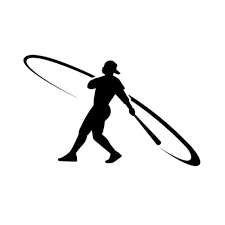
The bat left a trail of its projectile that revolved around the figure. The shadowy stance of Griffey, frozen mid-swing with weight fully transferred towards the back, bat already through the zone, and body rotated, makes the Swingman. The silhouette features a typical backward cap, one detail that makes it undeniably him.
2. Mike Trout (2014)
Nike corrected its 16-year-long marketing myopia in baseball by awarding New Jersey star Michael Trout a signature Nike baseball logo.
The firstborn of his Nike signature line, the Nike Lunar Vapor Trout, was launched on 22 June 2014, carrying Trout’s blazon. The badge-like shape of this logo also evokes a baseball home plate, directly connecting it to the sport.
Inside it, three angular strokes are arranged to make a stylized letter ‘M.’ The longest stroke at the center doubles as a vertical mark that forms the letter ‘T.’
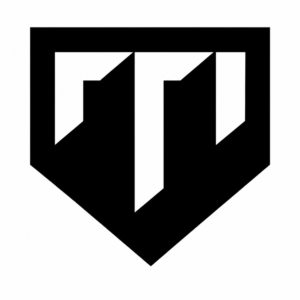
Sean Butterly, who also created other Nike athlete logos, designed Trout’s signature mark.
In May 2026, Nike Men’s Diamond released another shoe for Mike’s signature line, Mike Trout MCS Baseball Cleats. On its tongue, a raised TPU (Thermoplastic Polyurethane) overlay appears.
The three elements that form the mark are placed to mimic the player’s initials ‘M’ and ‘T.’
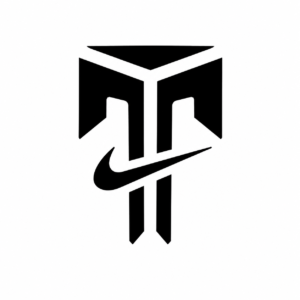
The Nike swoosh runs across two mirroring strokes, breaking their flow. The negative space between each element defines the letters and improves clarity.
3. Ronald Acuña Jr. (2022)
As Ronald Acuña Jr. evolved into one of Nike Baseball’s flagship athletes, the brand gradually expanded his visual identity beyond his 2022-released player-exclusive cleats. His first Nike baseball logo arrived on the ankle strap and tongue of Nike Alpha Huarache Elite 3 Low Cleats.
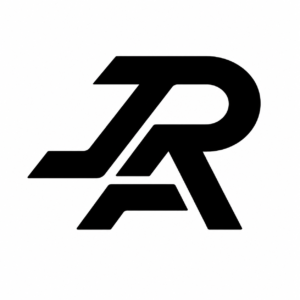
The ligature mark merged bold, italicized initials ‘A,’ ‘J,’ and ‘R’ into a compact design. The serif of the slanted ‘J’ extends and curves, doubling as the ‘R’ bowl. Moreover, the top bar of the segmented ‘A’ completed the form, which was connected through its diagonal stem.
In 2025, Nike launched a refined logo for the Ronald Acuña Jr. Collection.
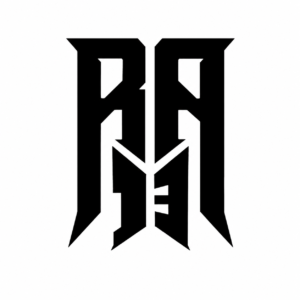
While the upper half features his initials, the lower section displays his jersey number ‘13’.
Note: Dual-sport athletes such as Bo Jackson and Deion Sanders, who played both baseball and football, also received Nike signature logos in 1989 and 1993, respectively.
Nike Baseball Home Plate Logo
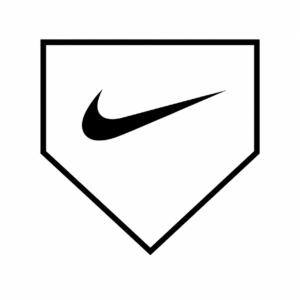
For its range of baseball training apparel, hardware, and other off-field equipment, Nike created a sport-specific emblem.
The Nike Baseball Home Plate logo is an example of symbolic minimalism. The swoosh is placed within the unmistakable outline of home plate.
Other Nike Athlete Logos
Nike’s sports portfolio is quite vast, covering not just baseball, basketball, football, and tennis, but also golf, boxing, and long-distance running.
Here are some prominent Nike athlete logos from other sports:
1. Tiger Woods (1998-2024)
There was hardly any sports section in the late 90s that didn’t feature news about record-setting golfer Tiger Woods at least once a week. Tiger Woods spent 26 years with Nike, during which two distinct logos graced his apparel line.
“Yin Yang” (1998-2000)
A year after Tiger Woods’ epic 1997 Masters triumph, Nike created a symbol that often goes unnoticed: the “Yin Yang” logo. The emblem symbolizes the balance of physical and mental personas, precision, and energy, qualities that define Tiger’s game. The logo also nods to his eastern and western heritages.
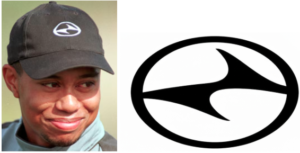
A clean, minimal oval makes the outer boundary of two interlocking organic shapes that mirror each other. An S-curve divides the two halves, reinforcing the yin-yang construction. Nike eventually opened it up to a wider public line, experimenting with color along the way. By 2000, Tiger had moved on, swapping the Yin-Yang for a monogrammed “TW” logo.
Tiger Woods’ “TW” Logo (2000-2024)
By 2000, the Yin-Yang logo became irrelevant as his dominance on the golf course outgrew that era. So, Nike refreshed it with his initials as part of a monogram. The mark arrived just in time for the Tiger Slam, the historic feat of holding four major titles simultaneously during 2000-2001.
The conjoined mark formed by the initials of his name, ‘T’ and ‘W,’ is set in a bold sans-serif typeface. The shared apex of ‘W’ and the vertical stem of ‘T’ interlock both letterforms. A black vertical rectangle with the base of an upward chevron enclosed this mark. The logo’s fate grew uncertain in 2024, when Woods and Nike ended their 27-year partnership.
2. Paul Rodriguez (2005)
Nike SB (Skateboarding) launched in 2002 and continued to expand its family by recruiting influential athletes. But Paul Rodriguez’s insistence on receiving a signature model before signing with Nike SB led to the creation of Nike SB P-Rod 1 in 2005, making him Nike SB’s first signature athlete.
The bold and capitalized ‘P’ and ‘R’ are constructed in a sans-serif typeface. The outer corners of both characters’ bowls were set at a 45-degree chamfered cut. The letterforms are arranged so that their hollowed-out parts weave through each other like a chain link.
3. Manny Pacquiao (2009)
The Filipino boxer, Manny Pacquiao, signed with Nike around 2006. He received his signature logo in November 2009. The mark was officially launched on the fight trunks he wore at the WBO (World Boxing Organization) welterweight championship against Miguel Cotto.
Following this high-profile exposure, Nike commercially released the logo across the Nike Trainer SC 2010 Pacciquio Edition, apparel, and merchandise. Manny’s initials ‘M’ and ‘P’ were created in a style that represents the player’s right fist shape. Mike Friolo is credited as the creator of this logo.
The indent between the diagonal stems of ‘M’ with flared terminals contains a sun-like form. It was inspired by the sun on the Philippines’ national flag. Apart from that, the ‘M’ sits above the flat-headed ‘P’ that anchors at the bottom through its spear-tip vertical stem.
Nike ended Pacquiao’s endorsement deal in 2016 following his controversial public comments.
4. Mo Farah (2017)
Nike commemorated Mo Farah’s remarkable career in long-distance running with a special edition Nike Air Pegasus 34 released in 2017. It featured his thoughtfully designed signature logo.
It’s a graphic illustration of Farah performing his famous ‘Mobot’ move, the trademark stance in which he arches his arms high overhead, fingertips touching his scalp to form an ‘M’.
It was created during an episode of the British comedy panel show, ‘A League of Their Own,’ and dubbed the ‘Mobot’ by James Corden. This signature gesture became Mo’s party piece, especially after his 10,000m gold medal at the 2012 London Olympics.