Honda Motor Co. Ltd. was founded by an engineer, Soichiro Honda, in 1946. The company had initially focused on manufacturing powered bicycles in post-war Japan. Now, more than 75 years later, it has expanded into a global company producing a large variety of cars, motorbikes, power tools, and other electronic items. The Honda logo has stood as a testament to the company’s identity and principles. The article traces the evolution of Honda’s logo over the years.
The Genesis of the Honda Cars Logo (1961 – 1969)
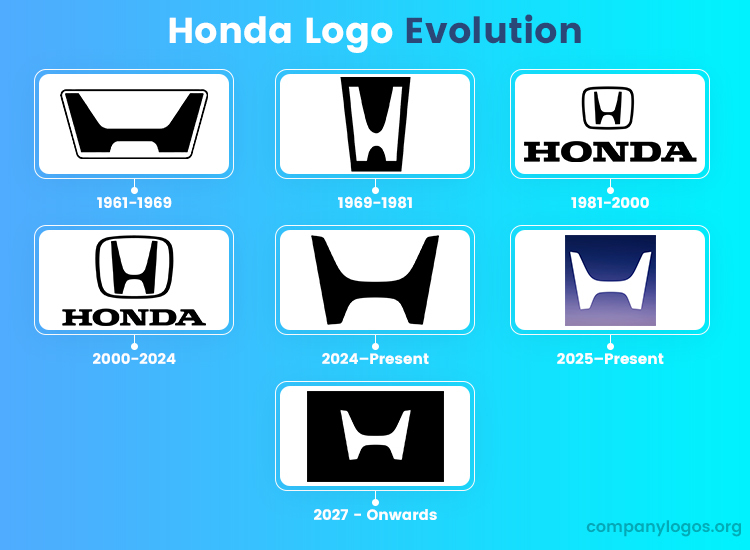
The original Honda cars logo was created in 1961, which featured a bold and massive letter “H” in black with its vertical bars spread away from each other diagonally placed on a white background. Besides, the thick crossbar did not quite appear at the centre, but rather near the bottom. The letter “H” with wide rear sides was enclosed within a trapezoidal frame having thin lines and rounded angles.

(1969 – 1981)
In 1969, the visual identity of the Honda logo was changed a bit, while keeping the letter “H” as the core element. Here, the letter “H” in white became bolder, but its contours were softened and its silhouette was narrowed. The trapezoidal frame in solid black became narrower and taller.

(1981 – 2000)
In 1981, the logo was drawn in a reverse colour palette, that is, the letter “H” in black placed on a white background. The frame looked more like a square with rounded angles. The graphical emblem comprising the letter “H” enclosed within a square-like figure was placed above an uppercase wordmark “HONDA” in black. It was executed using a bold serif font with large square serifs and geometric contours.

(2000 – 2024)
The 2000 logo design had refined the earlier logo a little. The lines of the letter “H” in black were elongated to almost touch the frame. However, the contours of the emblem were retained, and the massive serifs of the wordmark looked less aggressive and more harmonious.

(2024 – Present)
The latest Honda logo has a minimalist design that is identifiable by every car enthusiast. It features a bold letter “H” in black uppercase set against a white background. The crossbar is relatively shorter and more at the centre, which gives it a compact appearance. Each vertical bar tapers a little towards the centre, thereby adding an aspect of depth to the design.

(2025 Onwards)(For Electric Vehicles)
In 2025, Honda made a subtle shift in its branding by refreshing its logo design, especially for its next-gen EVs (series zero electric models). The design is a refined and modernised version of the logo introduced in 1961. The latest logo is sleek and aligns with the futuristic EV vision of the company. It moved away from the framing box with the letter “H” made wider and sharply angled. The logo features the letter “H” in white against a gradient purple background. According to the company, the logo resembles two outstretched hands to symbolise openness and commitment to customer needs.

2027: The New Face of Honda EVs and Hybrids
Honda has once again unveiled a new logo, this time symbolizing the arrival of its new EV and hybrid models, starting 2027. This new logo is very similar to the 2025 version, except there is no sign of the purple gradient in the backdrop.
The letter “H” forms the main part of the emblem and resembles the 1960s version. Compared to the 2025 logo, the edges seem curvier. This is why the brand is calling the 2027 Honda logo “The Second Founding”.
You will soon see this symbol on Series zero EVs, hybrid models, dealerships, documents, and branding.

Future Directions and Adaptations
As Honda moves into the era of electric and autonomous vehicles, its logo may shift to stay relevant. Some speculate that more transparent or 3D effects could be reintroduced to imply environmental friendliness or technological integration. The logo may also change to incorporate visual cues or themes related to mobility and connectivity. However, drastic change seems unlikely given Honda’s brand heritage and customer recognition.
Any evolution of the Honda logo will likely be gradual, with a commitment to maintaining its essence. The forthcoming first Honda electric SUV in 2024 may feature modern badging while retaining obvious visual links to established Honda styling. The mature, stately wordmark and signature red colour palette should continue anchoring the Honda brand. As technologies and societal values evolve, Honda’s identity will thoughtfully adapt to the future while respecting the brand’s history.

The Genesis of the Honda Motorcycle Logo (1947 – 1948)
The first logo for Honda motorcycles was released in 1947, which remained for a year. It featured a horizontally stretched blue banner outlined in gold and white with a wing-like object attached to the left. On the banner was written the brand name “Honda Motor” using a handwritten cursive typeface in white with a gold outline.

(1948 – 1953)
In 1948, the blue banner was made taller and wider, while the uppercase wordmark in red with a white outline was rendered in a sans-serif typeface. The thick gold frame around the blue banner had a “running” human element in gold to the right border. Also, there was a stylised golden wing with thin stripes placed right behind the human element, which covered the “Honda” lettering. This gave the logo a sense of logo.

(1953 – 1968)
In 1953, the logo redesign featured two metallic wings sans any lettering or colour palette. The wings represented speed and freedom, attributes that are dear to the riders of motorcycles.

(1968)
In 1968, the redesigned Honda Motors logo featured a horizontally oriented oval with the inscription “HM” in black inside. And below the oval appeared the wordmark “HONDA” rendered using thick outlines in an arched way. On top of the oval was a massive wing in black and white emanating from its left part and straightening up. The oval had a thick red outline as well.

(1968 – 1973)
In 1968, the logo was further simplified by removing the red oval outline and replacing it with a black and white one. Also, the arched wordmark “HONDA” was removed from below the emblem. The rest of the elements, including the lettering “HM” in a bold sans-serif typeface, remained.

(1973 – 1985)
In 1973, the wing element was refined by cleaning its contours and changing its colours to gold and black. The oval was removed, and the wing element was made to emanate from the massive “HONDA” wordmark in gold with a black outline. Written in uppercase letters, the wordmark sported the iconic Honda serif font, adding stability and professionalism.

(1985 – 1988)
In 1985, the previous logo design was further refined by making the colour palette of the wing element black, white, red, and blue. The wordmark was rendered in a white and black colour scheme, which made it look fresh, progressive, airy, and modern.

(1988 – Present)
The 1988 logo redesign saw the wing element being redrawn using thick red bars and rounded angles. The “HONDA” wordmark in red did not have any outlines and represented the power and professionalism of the automobile brand.

The Elements of the Honda Logo
Font
The iconic Honda logo is complemented by the word “HONDA,” written in a proprietary font associated with the brand. The uppercase letters feature a bold design with flattened tops and rectangular serifs. In 2000, the typeface underwent a subtle update, with the corners rounded to give the characters a more streamlined appearance. While this redesign had little impact on how the wordmark was perceived, it was deemed necessary by the company’s leadership.
Colour
The shape of the Honda logo has evolved over time and reflects different stages in the brand’s history. Today, it features a chrome-plated emblem, which is prominently displayed on vehicles as well as on promotional and commercial materials. Red, a colour often linked with royalty, serves as Honda’s signature colour for motorcycles. It is used as a background and, in some cases, as the colour of the accompanying text element in the logo design.
The History of Honda Cars
Honda was founded by engineer Soichiro Honda and businessman Takeo Fujisawa in Hamamatsu, Japan, in 1946. Soichiro used to operate as a mechanic who tuned vehicles and engaged in local races. With financial assistance, he ventured into manufacturing pistons under his inaugural company name. Thereafter, he secured a contract to supply pistons to Toyota. After World War II, the company was sold to Toyota, and Soichiro Honda utilised the proceeds to establish the Honda Technical Research Institute. The maiden motorcycle rolled out in 1949, while the first car was rolled out in 1963.
Over subsequent decades, Honda experienced substantial growth amid intense market competition. With time, Honda progressively broadened its product range by diligently cultivating a global market presence. In the mid-90s, the unexpected rise in consumer preference for larger, family-oriented vehicles prompted a swift corporate restructuring. This strategic shift enabled Honda to focus on market research and consumer-centric development and resulted in the introduction of iconic models like the Odyssey and CR-V.
Honda’s influence extended beyond automotive production. In 2005, the company unveiled an eleventh-generation robot called ASIMO, which was capable of ascending and descending stairs. Honda’s legacy in motorcycles remains significant. It has maintained its status as one of the largest producers of motorcycles and scooters in the world. Also, the company ventured into aviation with the creation of HondaJet. It featured cutting-edge engine technology that minimises drag, enhances efficiency, and reduces overall operating costs.
Finally
The Honda logo has undergone several key evolutions since the company’s founding in post-war Japan. The simple, aerodynamic wing logo reflected Honda’s spirit of innovation and mobility. The “double-H” design of the 1970s showcased a bold, performance-oriented identity. An oval, three-dimensional wordmark in the 1990s aligned with technological advancement and a contemporary sensibility.
Most recently, a streamlined, digitally optimised logo has maintained international appeal and timelessness. While the logo continues to adapt to an ever-changing future, it retains core visual components that honour Honda’s heritage through seven decades of industry leadership. The Honda logo remains one of the most distinctive logos worldwide and represents a brand that is synonymous with reliability, efficiency, and ingenuity.