NHK, or Nippon Hoso Kyokai, is the national broadcasting corporation of Japan and was founded by the Government of Japan on November 29, 1924. Based in Shibuya, Tokyo, NHK offers a plethora of radio, television, and online services. The programmes broadcast by multiple radio and TV stations owned by NHK include entertainment, news, culture, and educational programmes.
Over the years, the NHK logo has undergone a series of changes. These reflect the establishment of the organisation and its evolution as a public media institution. The article delves into the various logo changes undertaken by NHK, among other details.
The Genesis of the NHK Logo (1925 – 1926)
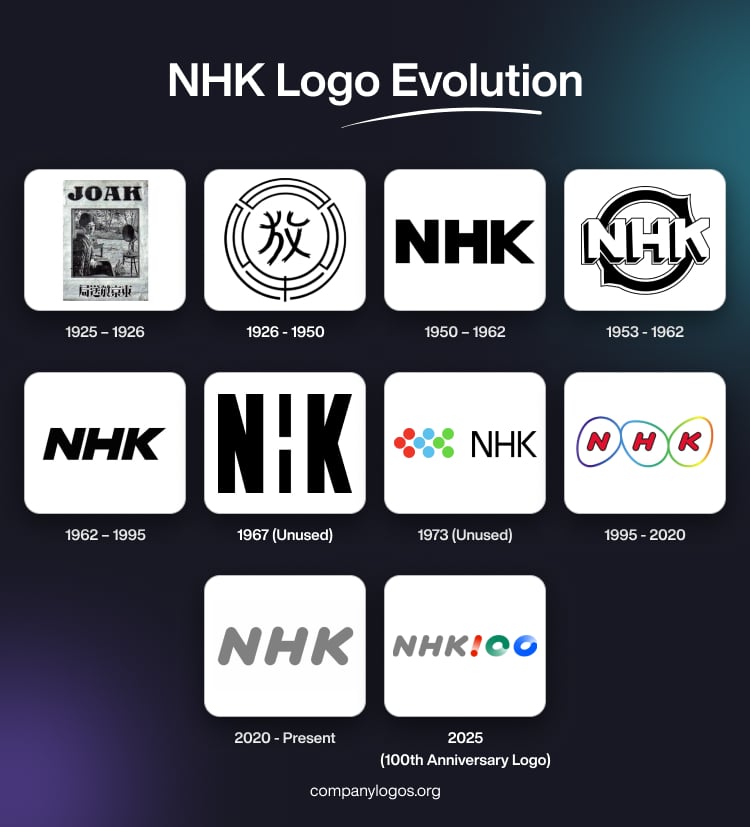
The original name of NHK was JOAK Radio, and its logo looked more like a poster in black and white. It featured a Japanese lady sitting by the side of a speaker with a wordmark in English above and in Japanese below. Thereafter in the same year, radio stations were opened in Osaka (JOBK) and Nagoya (JOCK).
(1926 – 1950)
In August 1926, the three radio stations in Tokyo, Nagoya, and Osaka merged to form NHK. However, the official name of the organisation before and during the Second World War was the Broadcasting Corporation of Japan. The logo of the period featured the brand name in Japanese enclosed within several concentric circles that were broken in places to form a pattern.

(1950 – 1962)
The 1950 logo iteration followed from the idea of using “the big three” of American broadcasters and the BBC, as laid down by the Civil Information and Education Section of the Allied Powers. Accordingly, “NHK” in black and rendered in a bold sans-serif typeface was constituted as an identifier of the organisation.
(1953 – 1962)
The 1953 logo iteration saw the abbreviation “NHK” written in white with black shadows and outlines to give a three-dimensional image. It was placed against a ring-like circular background in black with white outlines and two pointed bulges.
(1962 – 1995)
In May 1962, NHK officially standardised its logo as a wordmark, which was used consistently for over three decades. It showed the “NHK” wordmark in an italicised and bold sans-serif typeface in uppercase. The letters of the wordmark had spaces between them. This logo was typically superimposed on programme openings and closings. It helped establish a recognisable visual presence for the broadcaster.
(1967) (Unused)
Designed by Yusaku Kamekura, the 1967 logo iteration featured the elongated wordmark in a thick, bold, and black serif typeface. The middle of the abbreviated wordmark displayed the letter “I” cut into two equal parts.

(1973) (Unused)
The 1973 logo variant was designed by Rei Yoshimura, and it featured the wordmark written in the Univers typeface. To the left of the wordmark was an emblem consisting of 9 solid circles, where every set of 3 circles had separate colours. The red, blue, and green colours represented the primary colours of television. The solid circles represented the phosphor dots of colour television screens.

(1995 – 2020)
In 1995, to mark its 70th anniversary, NHK introduced a new logo designed by the Nippon Design Centre. This design featured three interlocked ovals (commonly referred to as “eggs”), where each contained a letter of “NHK.” The ovals symbolised new life, infinite possibilities, and a society of mutual support. The design also referenced the creativity of Columbus’s egg to underscore the commitment of NHK to innovation and knowledge dissemination.
The three ovals also represented three key concepts, such as pleasant living, new life and unlimited possibilities, and a cooperative society. The logo was intended to embody NHK’s vision for public broadcasting in a rapidly globalising and diversifying world.
(2020 – Present)
In May 2020, NHK updated its logo by removing the three ovals and retaining only the “NHK” inscription. It was displayed in a light grey colour and written in a bold, italic, and rounded sans-serif typeface. This move reflected a trend toward minimalism and digital adaptability. It made the logo more versatile for modern media platforms.

(2025) (100th Anniversary Logo)
To celebrate NHK’s 100th anniversary in 2025, a special commemorative logo was introduced. This design uses NHK’s signature grey wordmark in italics and incorporates the three primary colours of television screens, that is, red, green, and blue. Each colour represents a different aspect of NHK’s programming. For instance, red for entertainment (joy and creativity), green for education and welfare (care and growth), and blue for news (accuracy and credibility).

The Elements of the NHK Logo
Font
The wordmark used in the NHK logo is rendered using a bold, italicised, and rounded sans-serif typeface. The smooth lettering reflects confidence and progress.
Colour
The NHK logo employs a light grey colour, and the monochrome variants are based on the background and requirement.
Finally
Since the establishment of NHK, its logo has reflected the growing and changing role of the broadcasting organisation in Japanese society. What began as a simple wordmark has transformed into a symbol of creativity and inclusivity. Each logo iteration reflects the ongoing commitment of NHK to public service, innovation, and connecting with audiences across generations.