Airtable is an American cloud collaboration service company that builds and shares relational databases to simplify complex data organization. Founded in 2012, Airtable allows users to develop custom solutions to organise, manage, and share data, thanks to its powerful features and user-friendly interface.
The journey of the Airtable logo has been a remarkable one. Its 3D geometric shapes feature a modern and abstract design. From its inception to the present day, the Airtable logo has evolved and reflects the growth of the company and its ability to adapt to changing design trends. This article delves into the history and evolution of the Airtable’s iconic logo.
The Genesis of the Airtable Logo (2012 – 2016)
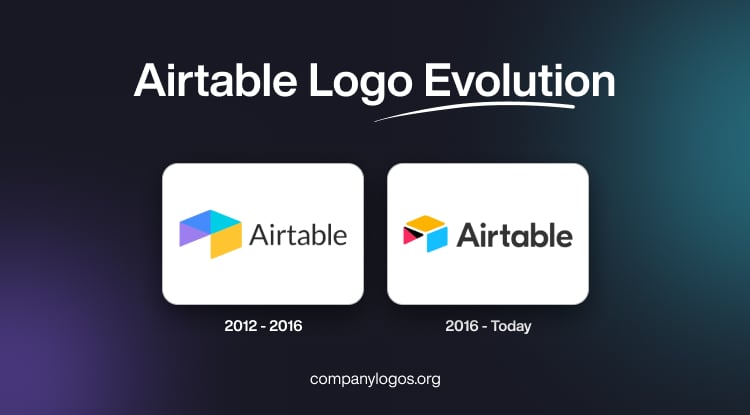
In 2012, when Airtable was still in its infancy, the logo of the company embraced a minimalistic approach. It featured a stylized 3D geometric figure that looked like a floating cube and was composed of distinct colours. These include teal, a shade of blue, flat purple, and yellow. These vibrant colours gave the logo an innovative and dynamic feel and symbolised wisdom, creativity, and energy. Alongside the graphical element was the wordmark “Airtable,” executed in bold black and in a sans-serif font.
The black wordmark stood in stark contrast to the multi-coloured geometric figure. Also, the letter “a” in the wordmark came with rounded contours to reflect the soft edges. In fact, the design of the letter “a” conveyed user-friendliness and approachability of the brand. The overall logo design embodied a combination of sophistication and simplicity. It showed the functionality of Airtable and its calculated approach to data management.

Embracing Modernity (2016 – Today)
As Airtable gained traction and expanded its user base, the company recognised the need to evolve its visual identity. As a result, in 2015, the logo underwent a significant transformation by embracing a more modern and geometric aesthetic. The new logo design has a graphical figure appearing like a stylized table and comprising three colours. And beside the vibrant and dynamic graphical figure lies a traditional wordmark rendered in title case and in a regular sans-serif font. The bold wordmark enhances readability compared to the earlier iteration.
The graphical figure comprises three geometric elements: a triangle and two parallelograms. And when it came to the colour scheme, the triangle sports a red colour with pink shades and a diagonal shadow cutting across the upper portion. The parallelogram placed on top appears in yellow, and the figure on the side looks radiant in a bright turquoise blue colour. Interestingly, the colour of the text “Airtable” stands in sharp contrast to the brightness of the graphical entity.
This updated logo aims to capture the essence of Airtable’s innovative approach to data management. It blends functionality with a visually appealing design. The geometric elements convey a sense of structure and organization. At the same time, the clean lines and bold colours display a fresh and dynamic brand personality.

The Elements of the Airtable Logo
Font
The Airtable wordmark bearing the name of the brand is executed in a traditional sans-serif typeface. Its clean lines and straightforward appearance are similar to fonts such as Reaktif Bold, Lto. Poligon Bold, and XXII Geom Bold.
Colour
The colour palette of Airtable infuses a burst of energy and delight into the otherwise conventional and staid typographic elements. The brand’s graphical element combines bright shades of yellow, turquoise, and red. These shades create a vivid contrast against the grey tones of the wordmark. This vibrant colour combination evokes a sense of progressiveness and creativity. Further, it effectively counterbalances any potential monotony associated with the typography.
Finally
Throughout its journey of evolution, the Airtable logo has undergone a single transformation. The redesigned logo iteration reflects the evolving design philosophy of the company and its ability to adapt to changing trends. Its current logo has remained a powerful visual representation of the core values of the company: functionality, simplicity, and innovation.