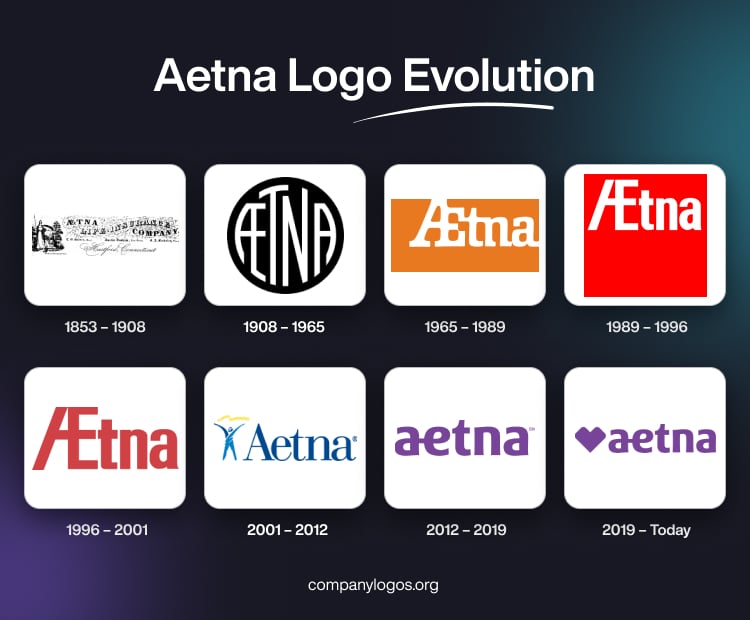
Aetna is an American health insurance provider known for its wide range of innovative healthcare products, wellness programmes, and strategies for integrated care. It was established by Eliphalet Adams Bulkeley in 1853 and is based out of Connecticut, the USA. The logo of the company has been a visual representation of its values, mission, and evolution over the past century and a half. It has been changed several times to meet the design trends of the era and the changing market dynamics. This article traces the journey of the Aetna logo from its origins to the present day. It reflects the growth and adaptability of the company and its commitment to its customers.
The Genesis of the Aetna Logo (1853 – 1908)
The original logo was in monochrome, featuring a lady warrior, probably Minerva, the Roman goddess, the patron of doctors, wisdom, and artists, and the wordmark “AETNA LIFE INSURANCE COMPANY” in an ornate serif typeface at three levels on its right. The graphic also featured a woman with a child in her arms, surrounded by trees. The letters “A” and “E” appeared to be fused together, and the wordmark was set against a floral background. The bottom of the wordmark had additional text comprising the nomenclature of the place where the company was founded. Under the lettering were the words “Hartford, Connecticut,” written in a calligraphic script.

(1908 – 1965)
The turn of the 20th century brought with it a new era for Aetna. It was marked by the introduction of its minimalist and iconic logo in 1908. The redesigned logo had the brand name written in white and a sans-serif typeface enclosed within a solid circle in black. The elongated letters had flat cuts and arched contours that appeared stylish and instantly recognisable. Incidentally, the first two letters of the brand name “A” and “E” were fused together.

(1965 – 1989)
As America entered the turbulent 1960s, Aetna recognised the need to have a more modern visual identity. So, in 1965, the company unveiled a new logo designed by the renowned firm Lippincott & Margulies. The new logo featured the letters “A” and “E” in a bold serif font connected in a ligature—a typographic element where two or more letters are joined into a single glyph. Set against a bright orange background, the design choice was far from arbitrary.
The ligature emphasised unity and continuity and reflected a company that values the wellbeing of its customers. This logo was persisted with for nearly a quarter century and become an integral part of the brand identity of Aetna. The ligature design was so successful that elements of it would continue to influence the Aetna logo for decades to come.

(1989 – 1996)
As the 1980s drew to a close, Aetna once again felt the need to update its visual identity. In 1989, the company brought out a revised logo that kept the “A” and “E” from the previous design but with a crucial difference: the letters in white were disjointed at the top. This was done to adhere to the new geometric grotesque font. However, the ligature remained intact, while the background of the design turned red. The centrally aligned wordmark was placed at the top of the red square.
The little disconnection of the letters “A” and “E” at the top was symbolic of the changes happening within Aetna and the insurance industry at large. It represented modernization and a willingness to adapt to new market conditions. The somewhat disjointed letters suggested flexibility and openness to change—qualities that became increasingly important in the rapidly evolving healthcare landscape.

(1996 – 2001)
The logo iteration of 1996 saw the logotype get a new colour scheme, that is, red set against a white background. Interestingly, the square base of the earlier variant disappeared. Moreover, the letters became more masculine, and the bottom half of the letter “t” was stretched and flattened.

(2001 – 2012)
The dawn of the new millennium brought with it another logo change for Aetna. In 2001, the company introduced a new design that separated “A” and “E” from the previous logo but with a colourful twist. The wordmark in a sans-serif typeface appeared in blue and was set against a white background. On the left of the wordmark was a graphic that depicted the schematic image of a man with raised hands and a yellow ribbon floating above. The image of a man was rendered in two different shades of blue. The flowing yellow ribbon conveyed the attributes of energy and optimism.
The design aimed to resonate with a broader audience and reflected the expanding range of services offered by Aetna. It also symbolised the determination of the company to meet the diverse needs of its customers.

(2012 – 2019)
In 2012, the Aetna logo was redesigned by the bureau of Siegel and Gale. It did away with the schematic human image of the previous logo and changed the wordmark as well. The new logo was rendered in a distinct purple colour, where the lowercase letters “a” and “e” in a modern sans-serif typeface were joined using a ligature.
This return to connected letters showed a renewed emphasis on unity and seamless service. Besides, the choice of purple suggested a forward-thinking approach while maintaining a sense of stability and trust.

(2019 – Today)
The most recent chapter in the evolution of the Aetna logo came with its acquisition by CVS Health in 2019. Following the merger, Aetna adopted the heart symbol from its new parent company and integrated it into the existing logo design. This heart symbol represents care, compassion, and well-being. These are the values that are at the core of both CVS Health and Aetna.

The Elements of the Aetna Logo
Font
The Aetna logo features a bespoke sans-serif typeface in lowercase that combines elegance with distinct characteristics. The most notable characteristics of the logo include the use of a ligature between the first two letters. The font is inspired by classic typefaces like FF Signa Pro Condensed or eSpectrum Extra Bold, and its smooth, soft lines give it a unique and refined appearance.
Colour
The rich purple colour of the logotype symbolises the innovative and forward-thinking approach of the company. It also conveys a sense of approachability and responsibility. The specific shade of purple has been carefully chosen to evoke feelings of serenity and reliability and to foster trust and confidence among the customers of Aetna.
Finally
The evolution of the Aetna logo over more than 150 years tells the story of a company that has consistently balanced respect for its heritage with the need to adapt to changing times. So, from the powerful imagery of Mount Etna to the sleek, modern design of today, each iteration of the logo has reflected the values and aspirations of the company at that point in time.