AT&T, or the American Telephone and Telegraph Company, is a telecommunications powerhouse that has been a prominent player in the United States for over a century. The company has become a multinational conglomerate from a small telephone company. In its journey, it has undergone numerous transformations, including changes to its corporate logo. The evolution of the AT&T logo is a fascinating journey that reflects the company’s history, strategic decisions, and adaptation to changing market dynamics. The article explores the changes in the logo of AT&T over the years.
The Genesis of the AT&T Logo (1885–1900)
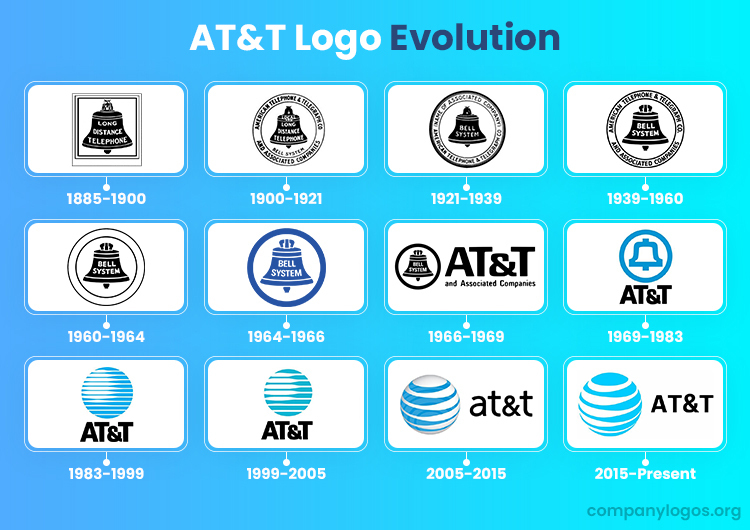
In 1885, the American Telephone and Telegraph Company was founded as a subsidiary of the American Bell Telephone Company. Its primary purpose was to manage and build the nation’s first long-distance telephone network. The original AT&T logo was a simple yet elegant design. It comprised a black-coloured bell image enclosed within a triple-square frame. Inside the bell was the wordmark “Long Distance Telephone,” written in a traditional font and a white colour palette in three levels.

(1900–1921)
The original logo was refined in 1900, wherein the triple square frame was removed and replaced by two concentric circles. And along the periphery of the circles appeared the wordmark “AMERICAN TELEPHONE & TELEGRAPH CO.” and “AND ASSOCIATED COMPANIES” in uppercase monochrome. And when it came to the main bell image, the word “BELL SYSTEM” was placed in an arched way below the bell. Also, the word “LOCAL AND” was placed on the upper part of the bell in white.

(1921 – 1939)
In 1921, the wordmarks both on the bell icon and along the periphery were changed. The wordmark on the bell was made shorter by keeping “BELL SYSTEM” in white. Further, in the upper part of the circular periphery, the wordmark “(NAME OF ASSOCIATED COMPANY)” was mentioned, while in the bottom part, the wordmark “AMERICAN TELEPHONE & TELEGRAPH CO” was mentioned.

(1939 – 1960)
The logo was redesigned in 1939, wherein the typeface was made bolder while the core elements remained more or less the same, with only the contours refined. The lettering along the periphery was changed to “AMERICAN TELEPHONE & TELEGRAPH CO.” and “AND ASSOCIATED COMPANIES.”

(1960 – 1964)
In 1960, the wordmark or lettering along the double circular frame was removed and the logo was simplified further. The logo now just had the black bell with three thin white lines at the top and bottom circumscribing it.

(1964 – 1966)
In 1964, the colour palette of the logo turned blue and white. The double circular frame around the bell image turned thick blue. The stylised bell, on the other hand, also turned blue, while the wordmark in white was retained.

(1966 – 1969)
In 1966, the name of the company was shortened to just “AT&T,” which was reflected in the logo as well. The solid and bold circular frame continued from the previous iteration but with a change in colour (blue to black.) The shortened name of the company “AT&T” appeared on the right of the bell emblem in big size, along with “and Associated Companies” in a small size.

(1969 – 1983)
Designed by Saul Bass in 1969, the logo had elements such as the bell redrawn with solid blue outlines, while the solid circular frame of the previous logo was retained, but in blue. And below the emblem, the wordmark “AT&T” was written in a solid, bold, and black colour palette.

(1983–1999)
In 1983, AT&T introduced a new logo that removed the iconic Bell System design. Designed by Saul Bass again, the new logo featured a simple, bold typeface with the letters “AT&T” in black placed below a stylised image of a globe. The globe in solid blue had a horizontal striped pattern in white emboldened on the left. This minimalist design aimed to convey a modern and forward-thinking image for the company.

(1999 – 2005)
In 1999, the logo was redesigned without changing its main elements and contours. However, the number of stripes on the globe was reduced, and the colour had a muted shade of blue. The solid, bold, black wordmark below the emblem remained without any change.

(2005 – 2015)
In 2005, AT&T began to focus on modernising its infrastructure and expanding its product offerings. It did so to include broadband internet, mobile services, and digital entertainment. And to align with its digital transformation initiative, AT&T introduced a revamped logo in 2005. The new logo featured a sleek, minimalist design with a modern typeface and a white globe-inspired symbol.
Interestingly, the colour combination was reversed for the globe. For instance, the horizontal stripes turned blue and were set against a white globe. The brand name in black appeared on the right of the globe in a lowercase sans-serif typeface. This design aimed to convey AT&T’s global reach and its commitment to cutting-edge technology.

(2015 – Today)
In 2015, the colour combination of the globe was reversed compared to the previous iteration, and the brand name was rendered in black capitals.

Impact and Legacy
The AT&T logo has become an iconic symbol in the telecommunications industry. It not only represents the rich history of the company but also its resilience and ability to adapt to the changing market conditions. The logo has evolved alongside the company. It reflects strategic shifts and technological advancements. Importantly, AT&T’s approach to rebranding and evolution of the logo has influenced corporate branding strategies across various industries.
The Elements of the Logo
Font
Previously, the graphical element in the AT&T logo had a three-dimensional design. However, the company opted for a 2D logo version to better align with the company’s image. The choice meant a fusion of style, simplicity, and versatility. The circular shape continues to symbolise the global reach of the brand, and the intersecting horizontal lines signify the interconnected telecommunications links between cities.
From 1969 to 2005, the logo’s text was displayed in Omnes. However, in 2005, designers made a switch to Avenir Medium, a font created by Adrian Frutiger. Over time, the style of the inscription evolved, and the size of the letters underwent a transformation. The inscription remained in lowercase until 2015, which was a departure from the norm in corporate branding.
Colour
The transition of the emblem from the classic black and white monochrome to the iconic black, white, and blue palette represents a seamless progression in colour coordination. It mirrors the evolution and modernization of AT&T.
Finally
The AT&T logo and its various iterations have become a timeless symbol of innovation, resilience, and adaptability in the telecommunications industry. Its enduring legacy serves as a testament to the company’s ability to navigate through periods of significant change. However, the logo maintained a strong and recognisable brand identity.
The AT&T logo is more than just a visual representation of the company; it is a symbol of the growth and transformation of the telecommunications industry. Its evolution reflects the challenges and opportunities that AT&T has faced throughout its history.