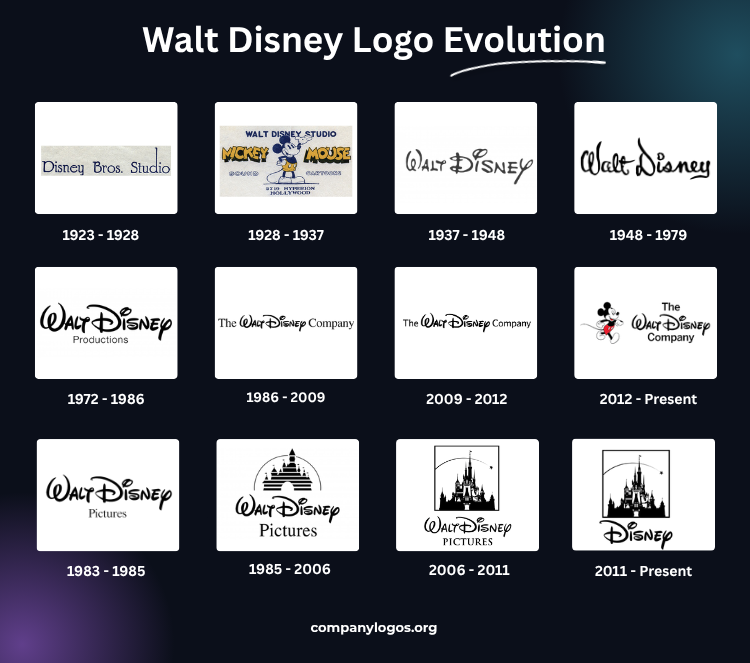
The Walt Disney Company has captivated audiences of all ages for over a century as a global entertainment hub. This California-based mass media conglomerate began as a small animation studio in 1923.
It has since grown into a powerhouse of creativity. The company’s ventures span film production, television networks, streaming services, theme parks, and merchandise that shape popular culture.
At the heart of this iconic brand is the Walt Disney logo. It is a symbol that evokes nostalgia and wonder.
This article traces how The Walt Disney Company logo has evolved. It also examines in detail the various logos of its film division, Walt Disney Pictures.
1923 – 1928: The Humble Origins
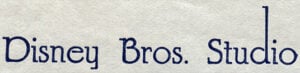
In 1923, Disney brothers Walt and Roy founded the ‘Disney Brothers Cartoon Studio.’ During those early years, the studio did not use a standardized logo. However, initial production materials featured the shortened name ‘Disney Bros. Studio,’ as shown on the letterhead above.
The only memorable element from this rudimentary, serif wordmark is the elongated stem of lowercase ‘d’ and the fact that it marked the beginning of a global media giant.
The brothers renamed their company to Walt Disney Studios in 1926.
1928 – 1937: Mickey Mouse Takes Center Stage
In 1928, Walt Disney and cartoonist Ub Iwerks created Mickey Mouse, making the childhood of several generations truly awesome and memorable.
As Mickey Mouse gained popularity, Disney decided to make him the face of their company.
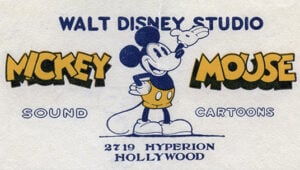
The first Disney logo, introduced in 1928, prominently showed Mickey Mouse in a detailed, busy, hand-drawn design. An image of Mickey with his famous cheerful expression instantly attracted attention.
The company’s then-name, Walt Disney Studio, and its address surrounded the main character. Other inscriptions, such as “Sound” and “Cartoons,” appeared in cartoon-inspired typography.
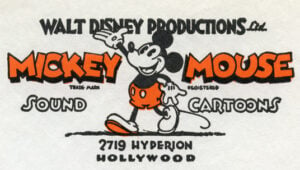
The 1929 Mickey Mouse logo featured the eponymous rodent in an altered pose with the company’s new name, ‘Walt Disney Productions Ltd’. As Mickey Mouse had become a registered trademark, the words “Trade Mark” and “Registered” also found their way into the design. The ink blue and golden yellow were replaced with black and orange, respectively.
The charming design perfectly captured the whimsical spirit of the studio’s early animations. It also helped establish a strong connection with audiences worldwide.
1937 – 1948: The Signature Wordmark Emerges
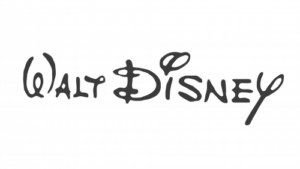
In 1937, Disney redesigned its logo, adopting a minimalist style. The beloved Mickey Mouse was gone, though not completely.
The wordmark logo featured just the founder’s name, Walt Disney, handwritten by him in a fancy, decorative, and playful style. The loops and tails of the letters added a whimsical touch.
You can also spot traces of Mickey Mouse in the letterforms: ‘W’, ‘D’, ‘I’, and ‘Y’ echo his ears and tail.
This signature logo was the earliest form of the wordmark we see today in every Disney movie and animated film.
1948 – 1979: The Disney Script Evolves
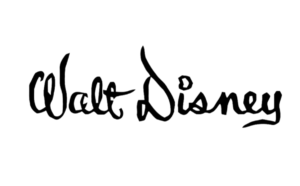
The Walt Disney logo introduced in 1948 was a refined version of the 1937 wordmark. The handwritten lettering had a distinct style and darker strokes. Written in title case, the wordmark had elongated strokes and varying line thickness. It was slightly difficult to read.
The sharp-edged letters were characteristic of Gothic typefaces, which Disney used for the font of the 1959 film Sleeping Beauty.
Although a new logo was introduced in 1972, this design remained in use until 1979.
1972 – 1986: Classic Walt Disney Productions Logo
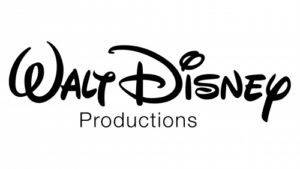
In 1972, Disney updated the signature wordmark with cleaner, more legible lettering, preserving the handwritten nature of the previous logos. Most modern audiences are familiar with this design as it most closely resembles the one we see today.
The addition of ‘Productions’ no longer portrayed it as merely a founder’s name but also as a business enterprise. Moreover, the use of formal typography and a smaller font size created a visual contrast with the artistic script above.
1986 – 2009: Renaming to The Walt Disney Company

In 1986, the company changed its name from Walt Disney Productions to The Walt Disney Company. The executive intended this change to reflect a diverse range of businesses, not just film production.
Consequently, they released a new wordmark, using the same signature style for “Walt Disney” and a formal serif typeface for the surrounding lettering.
The “Ta Da” Mickey Logo
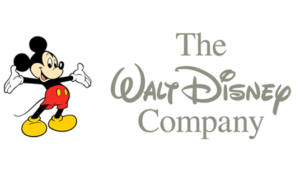
Introduced in the late 1980s, this Walt Disney logo featured Mickey Mouse in an enthusiastic pose. It was referred to internally at Disney as “ta da Mickey”. Furthermore, the wordmark appeared stacked across three lines and in light grey rather than black.
Disney used this logo in corporate communications and store branding.
2009 – 2012: Further Refinement of Walt Disney Logo

In 2009, Disney refined its 1986 logo by updating the typography around the Walt Disney signature. They replaced the serif typeface with the sans-serif Whitney. The overall structure remained the same.
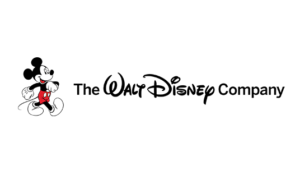
A new version of the ta da Mickey logo was released that same year, featuring a walking Mickey Mouse and borrowing the signature wordmark, with a seemingly bolder typeface for ‘The’ and ‘Company’.
2012 – Present: Adopting a Bolder Look

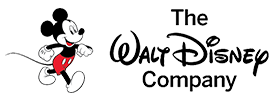
In 2012, the company changed the logo typeface from Whitney to Benton Sans, giving the lettering around the Walt Disney signature a bolder look.
A stacked version of the logo appears on the company’s official website alongside Mickey Mouse.
Logos of Walt Disney Pictures
On April 1, 1983, Walt Disney Pictures was incorporated as the dedicated live-action film division of Walt Disney Productions.
1983 – 1985: The First Walt Disney Pictures Logo
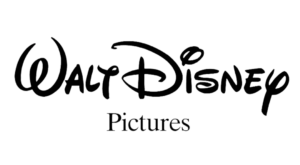
The brand introduced a separate Walt Disney Pictures mark by replacing “Productions” in the 1972 Walt Disney logo with “Pictures”. The letters were larger and set in a serif typeface.
This logo helped establish Walt Disney Pictures’ distinct identity.
1985 – 2006: The Castle Makes Its First Appearance
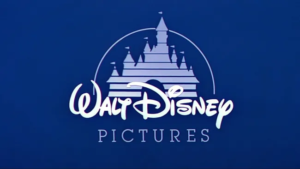
In 1985, the Walt Disney Pictures logo underwent its first major transformation. It featured the silhouette of a stylized castle set against a dark blue background, coupled with the signature wordmark, and surrounded by the arc of a shooting star.
Made with horizontal stripes in bluish white and having six flags, the castle was based on Disneyland’s Sleeping Beauty Castle, which itself is inspired by the Neuschwanstein Castle in Bavaria, Germany.
The wordmark shows the classic Walt Disney signature in white. Letters of the word ‘Pictures’ appear entirely in uppercase in the same shade as the castle and the arc.
The castle debuted in an incomplete form in the 1985 movie Return to Oz. A fully animated version arrived later in the year with the animated film The Black Cauldron and was accompanied by a musical arrangement of the song “When You Wish Upon a Star” from the 1940 Disney movie Pinocchio.
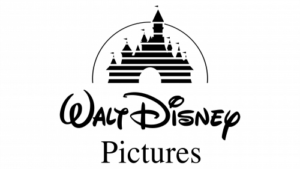
In 1986, a standardized version of the Disney castle logo was released. Rendered in black or blue, the castle’s silhouette appeared above the wordmark borrowed from the 1983 design.
The castle became a symbol of the enchanting worlds that Disney created. It captured audiences’ imaginations and invited them to experience the magic of its stories. For people growing up in the 80s and 90s, it is the most widely remembered Disney logo.
2006 – 2011: The CGI Castle Revolution
In 2006, the Disney castle logo, created with advanced computer-generated imagery (CGI), made an appearance with the release of Pirates of the Caribbean: Dead Man’s Chest. A vivid, highly detailed castle that blended Sleeping Beauty Castle and Walt Disney World’s Cinderella Castle occupied the screen.
The animation features the sky, clouds, rivers, fireworks, a 3D view of the castle, and a shooting star flying from right to left above it, forming the arc.
Beneath the castle, the wordmark appears in polished, silver, embossed lettering. The logo reminds us of Disney’s ability to transport audiences to the realms of fantasy and wonder.
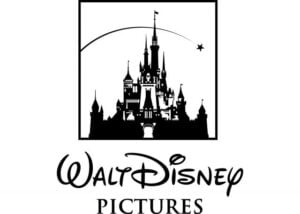
The standardized version of the 2006 Walt Disney Pictures logo features the silhouette of the new castle, the arc, and even the shooting star that forms it. The stripes have disappeared, and the details have emerged. The wordmark from the previous standardized version has been updated, with “Pictures” now in all caps to echo a sense of grandeur.
2011 – Present: Disney Branding Update
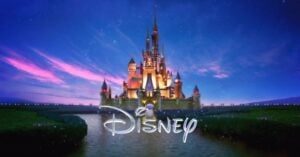
In 2011, Walt Disney Pictures dramatically simplified its branding by dropping “Walt” and “Pictures” from its classic signature wordmark. The mononym “Disney” continued to appear in the familiar script and silver-embossed lettering.
This CGI castle logo, featuring the updated branding, first appeared in the 2011 movie The Muppets.
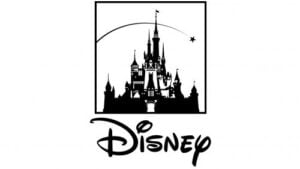
Mirroring the movie version, only the “Disney” wordmark stayed in the standardized logo, making it adaptable across merchandising, theme parks, and digital media. The highly detailed depiction of the castle is retained, along with the classic elements of the shooting star and the arc.
Castle Logo Movie Customizations
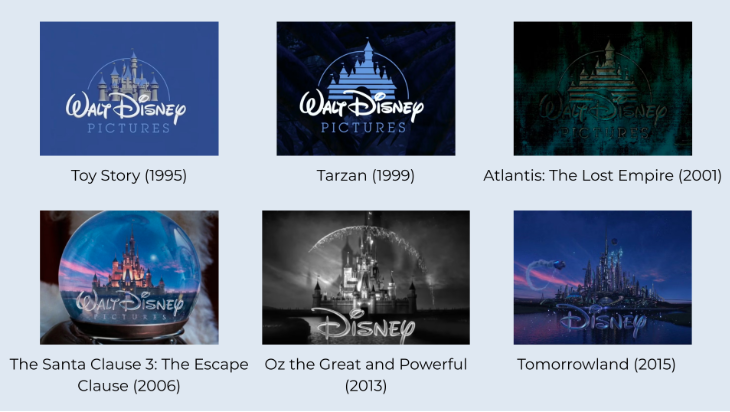
Beginning with the 1995 movie Toy Story, Disney has frequently customized its castle logo animation to reflect the world of each film. Rather than using the standard opening animation, the studio often alters the castle’s appearance, colors, music, and surrounding environment to match a movie’s setting and tone.
Other Versions and Variations
Detailed below are the other versions of the Walt Disney logo:
Merchandising and Corporate Communications
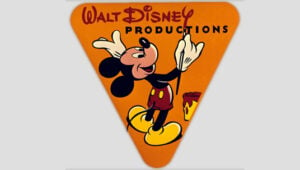
A version of the Walt Disney Productions logo, introduced in 1948, depicted Mickey Mouse with a paintbrush in his hand, painting “Walt Disney” in a script that would eventually evolve into Disney’s signature typeface.
The company used this logo on acetate records, DC generators, matchboxes, and other materials.

The above version of the Disney logo resembling Mickey Mouse’s head was first used in the mid-1960s. It showcases a globe made of thick black latitudes and longitudes. Two solid black circles mimicking Mickey’s ears featured above the globe.
The logo in its various iterations appeared on annual reports, directories, and other corporate materials between 1965 and 2005.
Finally
The Walt Disney logo has seen a remarkable evolution over nearly a century, reflecting the company’s growth from a small animation studio to a global entertainment giant. From the early days of Mickey Mouse-inspired emblems to the distinctive wordmark derived from its founder’s signature and the CGI-heavy fantasy world of the iconic castle, the logo has consistently preserved its sense of wonder and imagination.
Over the years, The Walt Disney Company embraced a minimalist logo aesthetic, while Walt Disney Pictures developed a rich visual identity through a series of themed castle logos tailored to each film. Despite the creative transformations, the signature wordmark in the classic Disney script remained the unifying element at the heart of both brand identities.
The Walt Disney logo serves as a constant reminder of the company’s unwavering focus on creating magical experiences that resonate with audiences’ emotions worldwide.
FAQs
1. Why was the first Disney logo a picture of Mickey Mouse?
Walt Disney and Ub Iwerks created the iconic Micky Mouse character in the late 1920s. Its success and popularity led Disney to make it the focal point of its branding in 1928.
2. Is the castle in the Disney logo a real place?
The castle in the Disney logo is inspired by a real place. The original castle logo, introduced in 1985, was modeled after Disneyland’s Sleeping Beauty Castle, which was itself based on Neuschwanstein Castle in Bavaria, Germany. The 2006 redesign featured a castle that blended elements of Sleeping Beauty Castle and Walt Disney World’s Cinderella Castle.
3. Why is there an arc in the Disney logo?
The arc in Walt Disney Pictures’ logo traces the path of a shooting star, a nod to the song “When You Wish Upon A Star” from the 1940 Disney movie Pinocchio.